
I haven’t written anything here in a long time, mostly because I’ve been busy, but also because I hadn’t really felt the need for the outlet that this site has been for me. But I’ve been thinking a lot about what’s happening in Israel since October 7, and the hearing in Congress yesterday has me eager to express some thoughts.
To be clear, I am a Jew. I was raised by two Jewish parents. I was not raised in a particularly religious household and (as is pretty clear to anybody who’s read lots of other stuff I’ve written here) I’m an atheist, but I absolutely and without question identify as a Jew.
The attack on Israel on October 7 and the aftermath had a pretty striking impact on me. It forced me to analyze things that I hadn’t fully analyzed, and it gave some clarity to a narrative that I hadn’t fully thought about. Shortly after October 7, there was a Palestine solidarity march on my university campus. It went through a part of campus that I can see and hear from my office window, and I heard and saw it. I used Facebook as an outlet for my thoughts that day.
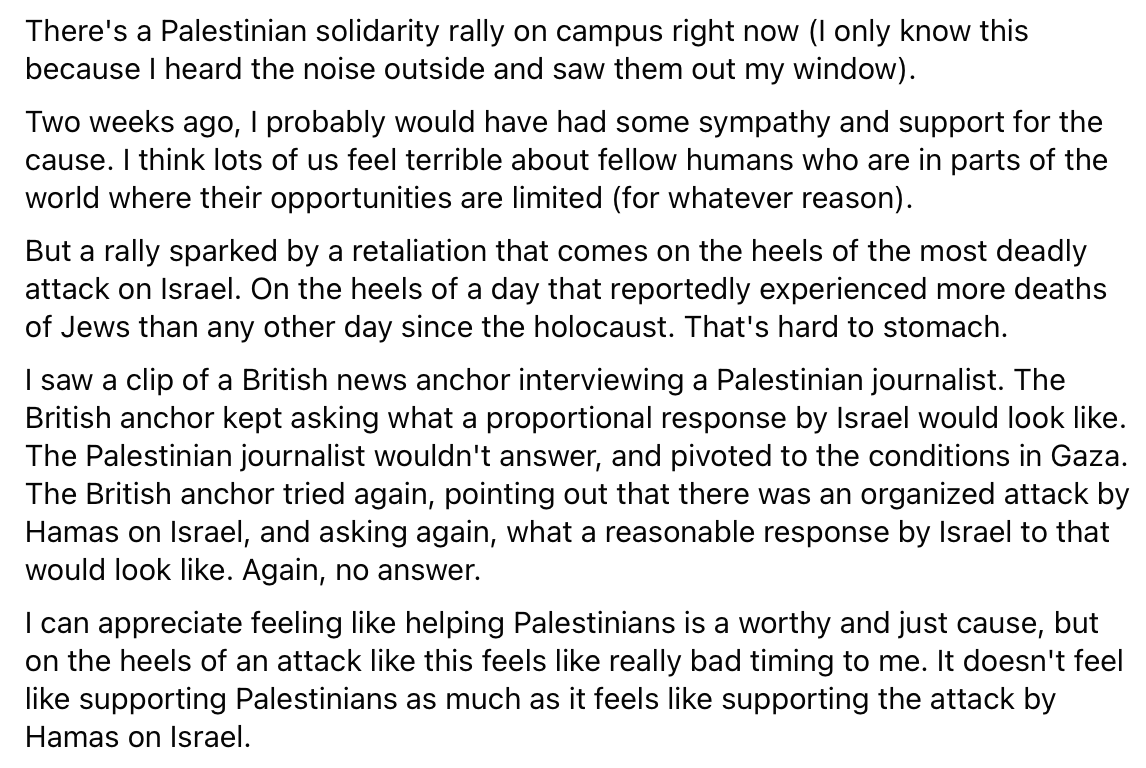
An old friend, somebody I don’t know well, but respect and have had good interactions with on Facebook, added a comment. “Pretty disappointed in you saying something like this. You are one of the smartest people I know on here and generally the most thoughtful in trying to understand all sides even when you disagree. When would be the right time for you? Bad timing is 70 odd years of Palestinians putting up with their land being stolen, living under the oppression of an apartheid state as the world watches on. When will be the right time?”
When will be the right time? My response: literally any time other than in the wake of the largest death toll of Jews on any day since the holocaust.
The discourse about October 7th and Israel’s response hasn’t gotten much better since then. What’s worse (in my mind) is that the rhetoric of the Palestine solidarity movement is so much more anti-Israel than pro-Palestinian. Maybe there is no separation, but I don’t think that’s true.
A critical piece that I think lots of people fail to understand is this: rhetoric like “From the River to the Sea” and “globalize the intifada” is antisemitic. Many will argue that they can be anti-zionist without being antisemitic. I give those people the benefit of the doubt and believe that they do not hate Jews as much as they might be accused of hating Jews. But here’s the missing piece: many Jews (and I’ve come to be one of them) believe that the continued safety of Jews in the world depends on the existence of the state of Israel. Without Israel, Jews are not safe. I appreciate that point being debatable, but it’s a reality in the minds of many of us.
If we recognize that premise, that the existence of Israel is required for the survival of Jews in the world, then calls to end Israel are no different than calls to end the existence of Jews in the world.
I firmly believe that a large portion of those waving Palestinian flags and chanting “from the river to the sea” or “globalize the intifada” don’t think they’re being antisemitic. Surely some are, explicitly, but I think that many, hopefully most, aren’t. Many of these folks push back when confronted with the idea that anti-zionism is the same as antisemitism. I get that. It’s easy to imagine being cool with Jews as people, but being against their desire to form a state at the expense of others who live on the land where that state will be (or is). But it’s only because that piece is missing. That piece that says that the existence of Jews requires the establishment and maintenance of a Jewish state.
I think a lot of this stems from so many people in the world taking it for granted that they are represented by a country somewhere. They are legitimized by having that. I think it’s important in all of this to recognize that Jews are 0.2% of the world’s population and that there are many examples in history of attempts to eradicate Jews. Not just to push Jews out, but to eradicate Jews. Not just to kill some population of Jews in some part of the world, but to end the existence of Jews completely. For a Jew, that is frightening, and knowing that there is a nation that would always be a refuge, and that has military strength to intervene, is comforting. A comfort that many probably don’t need to have in this world, and that many who might feel they need already have in droves. There are several countries with a Hindu majority. There are dozens of countries that recognize some form of Christianity as the national religion, a handful of officially Buddhist nations, dozens of countries that established Islam as the state religion, and for all of these, there are many more that have majority populations of these religious groups and that consider these religions to have special status. But there’s only one country with Judaism as the state religion and only one place on earth with a Jewish majority population. It shouldn’t be difficult to understand why this is important to Jews and those who support Jews. But for some, it seems hard to remember that. As a Jew, I wish it weren’t so hard.
 Hitting Bregma